Saturday, March 22, 2014

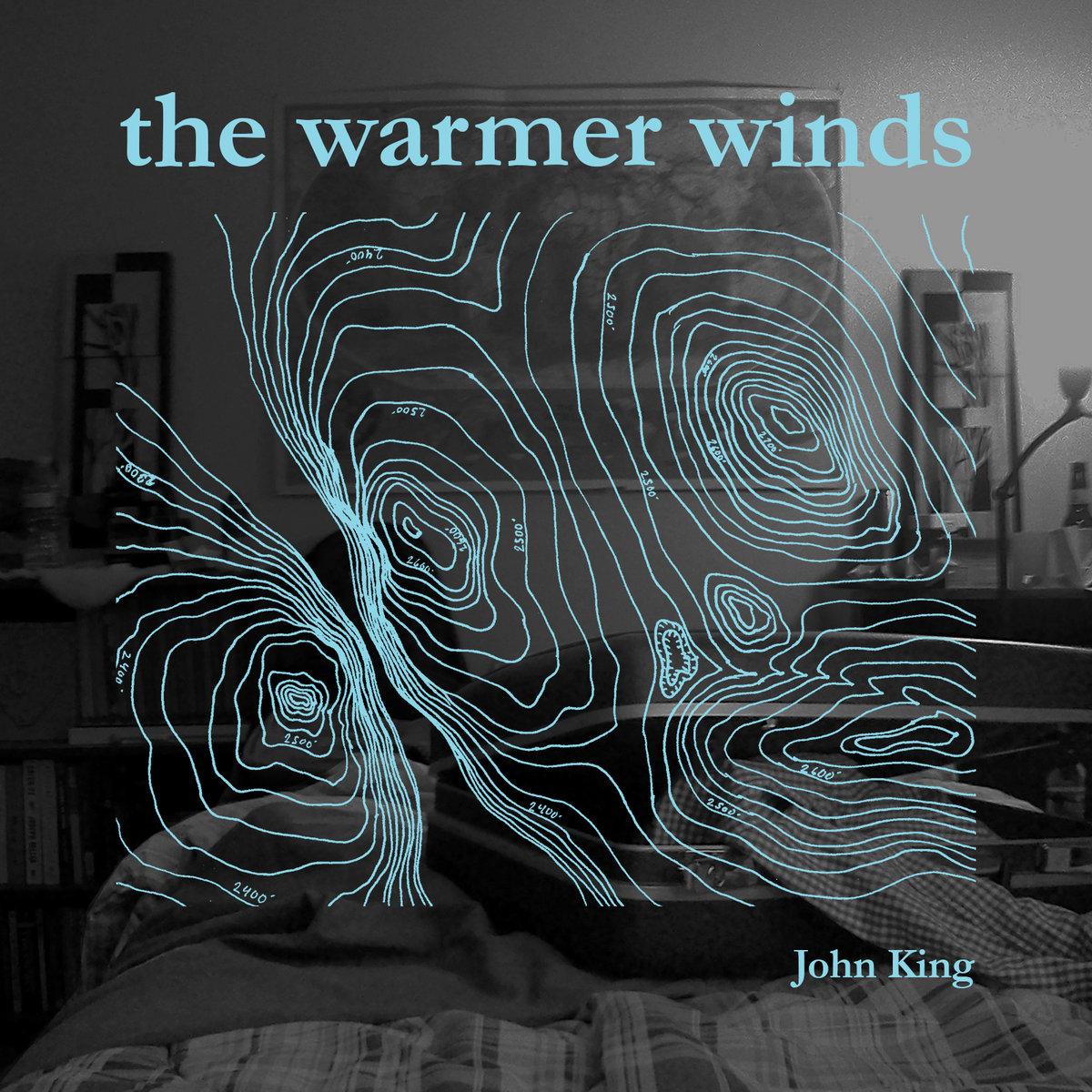
John King ~ The Warmer Winds


8.3

As with my most recent post, I feel the need to begin with an explanation of how my relationship with the artist whose album I'm reviewing might affect my opinion of said album. In this case, the artist is not only another former Malone student, but also a personal friend. In fact, it is doubtful that I would have ever heard this album without knowing John, or at least going to school or living in Canton with him. But, that doesn't mean that I'm giving him or his music any sort of free pass or local artist handicap. Like many twenty-something-year-olds, I know a fair amount of people who play music alone or as part of a band, and I will readily admit that I don't regularly listen to a majority of their music. I will also say that I do listen to John's music, both as solo artist and part of A Minor Bird, and with good reason.

If The Warmer Winds has one great weakness, it is the album's somewhat lopsided nature. Five out of the album's first seven tracks all have the sort of songwriting brilliance that makes John King stand out as a big fish in a small pond. "The Woods" seems to have stood out to John himself, since it's the only song (to my knowledge) to have an accompanying video. The song is a gorgeous, mostly acoustic ballad that strikes a wonderful balance between ethereal and folksy. That same sort of haunting beauty filters in and out of the entire album, usually presenting itself most clearly when the lyrics are the most vulnerable, open, and honest. A perfect example of this comes at the end of "Badlands," when John sings of the "two wandering boys with tattoos on their darker skin," and how they were "sent away in the name of our protection." In moments like that, the synchronization of music and lyrics is so dead on it's hard to believe that this is a debut album from an artist of such little acclaim. That shock might be even greater on "500 Nights Alone," which I consider to be an absolutely timeless folk-rock gem. One of the fullest sounding tracks of the album, "500 Nights" showcases John's skill with an electric guitar, as well as his ability to transition from a delicate falsetto to a near yell without jolting the listener so much as pleasantly surprising him or her. On top of those delicious guitar licks and versatile vocals are added the extra vocals of Anya Antonavich (I could be wrong on that, but it certainly sounds like her distinct and talented pipes), which add an extra dimension to the song, both musically and emotionally. John also gets help from others on "Tomorrow's Song," a creative piece that combines some of the album's most ambient sounds with its most raucous, moving from one voice over droning background music to a collective shout accompanied by clapping hands, tambourines, and general chaos, and then back again. If I remember correctly from a show John played at, the track is based loosely on a dream he had, and the songs opening and closing do a great job at letting the listener in on that.

As I mentioned, the weakness of the album seems to lie in it's unevenness. After many listens, I can't help but split the album into two distinct halves, the first ending with "500 Nights Alone," and the second beginning at "Phono Mind." After a few listens, I would have said that the first half is about a 9/10 and the second a mere 5 or 6, but at this point I think I've realized that both are much more equally powerful than they let onto at first. It should be clear from my last paragraph that the songs on side A are quite good, and most do well standing on their own. In fact, if one had to choose one of them to play as a radio single, the decision would be a close call between most of them. The same cannot be said of side B, which contains the album's three longest tracks, which all surpass the 6-minute mark, just a bit beyond typical single-length. But, these longer, almost rambling tracks create a cohesive when listened to together. Part of this comes from the two transitional pieces that round out the half-album set, but it is also from their overall feel and sound. As indicated by both the suitcase and the topographic map on the album's cover, The Warmer Winds is definitely a travelogue of sorts (just take a look at some of the song titles), and the sound created on side B reflects that. John doesn't quite create the open road sound of a Springsteen or the Doobie Brothers, but there's a certain quality of his music that gives one the feel of heading into the unknown. The same way that highway miles tend to be forgotten on a long drive, the minutes tend to fade away as The Warmer Winds rolls on. The best analogy I can come up with is that the second half of the album is kind of like "fly-over" states: easy to forget the names and order of if you've never lived in one of them, but mysteriously vast and beautiful once you take the time to really squint your eyes and look closely. When you pair both sides of the album together, there's plenty to explore, regardless of whether you'd prefer to scope out the big attractions or see the sights off the beaten path.

Saturday, March 8, 2014

Over the Rhine ~ Meet Me at the Edge of the World


9.3

One could accuse me of having a bias on this review. After all, OtR and I are both from Ohio, and the band's core members even went to the same college that I just graduated from. Not only that, but Meet Me continually returns to themes of home, and not just in the generic sense, but in a very real, specific, Ohio sense. But, then again, one could also accuse me of being biased against this band for those very reasons. I love getting out of Ohio (as do most Ohioans that you talk to), I've never had much school spirit, and as a newlywed living in a small, rented space I'm not entirely sure what the concept of "home" means to me right now. So, I'd like to think that any of those causes for bias are simply false accusations, or at the very least might balance each other out. The latter is more likely true.

Now that all of that has been (almost surely unnecessarily) settled, I want to talk about one of the best new albums I've heard in a long while. Although it didn't appear on any of the number of "top albums" lists for 2013 that I came across around New Year's time, this is my unofficial #1 from last year. Meet Me is a double album that spans virtually every mood OtR's catalog has touched, at least over the past 15 years. (I am, very unfortunately, not familiar with the band's earliest work). They sound as bright as ever on tracks like "Highland County" and the bluesy "Gonna Let My Soul Catch My Body," while still turning down the lights for "I'd Want You" and "All Of It Was Music." But, what's more impressive than the band's transitions from cheerful to mournful to reminiscent to optimistic is the comfort with which they make all those moves. There is not a single note on the album that feels out of place, and yet it somehow feels as if the entire nineteen-song collection could have been improvised from a porch-swing at the Detweiler-Bergquist homestead. That sentiment is emphasized when the album closes with "Favorite Time of Light," a song that perfectly captures what the end of a day means for two people who have had their struggles and yet are still fully devoted to one another. One can't help but imagine the couple sitting on their front porch, paint-chipped and falling apart in that character-enhancing sort of way, as they harmonize: "So add this to your list of simple beauties / I know we're gonna miss it when we go / while barren fields undress their gentle mysteries / we dream an ocean in Ohio." Like much of the album, it is beauty and sadness mixed in just the right proportions, and it is not only brilliant but somehow heartwarming.

I believe that mixture of beauty and sadness, while it certainly stems partly from the couple's own life experiences, must also come from the place they call home. Regardless of how much the members of OtR have experienced it firsthand, the Rust Belt of Ohio and its neighbors has a history, and that history can be felt. It can be felt in the driving minor key and whining strings of "Sacred Ground." It can be felt in the cautious optimism and defiance of "Don't Let the Bastards Get You Down." It can be felt in the content submission of "It Makes No Difference." But, though that history can be felt, it is never simply accepted. Over the Rhine are certainly aware that Ohio, especially certain parts of Ohio, is a land that has been beat down, but they are also part of that land that refuses to give up. The upbeat blues of "Baby If This Is Nowhere" drives that point home, and it does it with an infectiously fun spirit. As Bergquist puts it, the sky is the one who's "got a big ol' case of the blues." 

In a way, that song serves as the thesis for the manifesto that is Meet Me at the Edge of the World: "Baby if this is nowhere / how sweet it is to find." In other words, who cares about stuff? Bergquist and Detweiler have everything they need to be happy, and it isn't all that much. Thinking through every song on Meet Me, it's difficult to name one material possession that's mentioned in these songs. Sure, there are a few references here and there when one really digs through the lyrics, but they're to things like a "brokenhearted piano" and a "mailbox full of weariness." As the song "Called Home" puts it, "And stories they get passed around / and laughter, it gets handed down." Anybody can tell you to stop worrying, that life is beautiful and you should be content. And yes, I believe very deeply that they would be correct, but I also know that those things are hard to accept, especially as generic statements. Such things take more than a breath to convince anyone of, and Over the Rhine have essentially used nineteen songs to do just that. And they haven't done it by carefully cropping out the bad parts, or skimming over the sadness, or ignoring the harder issues that plague us. They tackle the winters, storms, and droughts of life. They even tackle the idea of death, in "Wildflower Bouquet," and managed to write one of the most simple and beautiful songs that you will ever hear in the process. They've given us a view of life that is difficult, confusing, sad, happy, funny, anything you can think of; but more than anything else, they've given us a more complete view of life than most artists are willing to portray, and in that wholeness there is a life-affirming, tear-inducing, toe-tapping, heart-warming, soul-satisfying beauty.

Monday, February 24, 2014

The National ~ Trouble Will Find Me

8.5


There are a number of different ways an album can make one feel sad, but in my experience I would classify most of these under two main umbrella categories: sorrowful albums and sad albums. Trouble Will Find Me really appears to belong in the latter of those two categories, and yet it feels more sorrowful than sad. Doubtless, all of this requires some explanation. When I say 'sorrowful albums' I am referring to those albums which focus on some sort of tragedy, there is a substance behind the artist's sadness. When someone has something to really be broken up over, his or her sorrow tends to feel much more real. I think of William Fitzsimmons' The Sparrow and the Crow, a divorce album so intimate and barefaced that I haven't been able to stomach its entirety since meeting my wife. At the other end of the spectrum is an album like Morrissey's Ringleader of the Tormentors. The man may have a good amount to say in a lot of his work - and don't get me wrong, I love the Smiths - but, Ringleader is mostly the Moz wailing about nothing. This, as far as I see it, is what separates simply sad albums from truly sorrowful albums. And, while sorrowful albums often create a powerful impact for the listener, the feelings stirred by sad albums are typically as fleeting as the substance which is being sung about.

All of that to say that Trouble somehow fits the billing of a sad album while delivering the emotional punch of a sorrowful one. Matt Berninger's songwriting is a mix of melancholy and mundane, everyday life in plain speech interspersed with enigmatic lines of poetry. One song contains both the line "I'm tired, I'm freezing, I'm dumb" and the lines "when they ask what do I see / I say a bright white beautiful heaven hanging over me." At first, it's hard to swallow the odd combination of first person prose and poetry, but eventually the two become so connected that there really is no difference between them. Berninger simply interprets his life as a poetic tragedy of sorts, and it's never really overstated or melodramatic, just confusing and realistic. Sure, there are occasional slips into territory that feels contrived and over-poeticized ("under the withering white skies of humiliation"), but the melodrama is sparse on this album. The sorrow here is small, but real.

From what I know of The National's discography, that realism seems to be their most brilliant quality, and I really do mean brilliant. Even if I may be a married man in his early twenties living in the suburbs, Trouble really makes me feel as if I know what it's like to be ten years older, single, and living in a city. And it doesn't just paint a picture of what that life looks like from the outside, but it really gets inside the heart of someone in that situation. It gets specific enough to feel truly personal by using first names (Jenny, Jo, Davey), first person, and dialogue. But, it also stays generic enough to allow the listener to become the "I" in every song. It's through that vicarious living that Trouble delivers its blow. And not that you necessarily feel the sadness that's being sung about, because honestly, a lot of it isn't all that sad. But, you feel sympathy for whoever really is experiencing everything that the album is built upon. Sure, he isn't going through anything traumatic, there is no unexpected death or painful separation, but he's a real person and he's going through a hell of a lot. And not only that, but he's normal. By the end of the album it's easy to realize that pretty much everyone's going through a hell of a lot, and Trouble finds a way to make you dwell on that reality, and it sort of breaks your heart.

Wednesday, February 12, 2014

Young the Giant ~ Mind Over Matter

6.7

If Young the Giant's self-titled debut was a hot, sunny day (they did record a live version of "I Got" in the desert), then Mind Over Matter is the hot summer night that follows. A few tracks still carry the same brightness that much of the band's previous album contained; but even these sunny spots, namely "Daydreamer" and "In My Home," feel more like speeding into the sunset than strumming guitars on a warm afternoon. In a way, this dimming of the lights takes away from the upbeat and carefree sound that drew me to Young the Giant (then The Jakes) in the first place. But, it also provides a route for more a meaningful, if slightly dark, message. Consistently throughout the album that message tends to lean towards regret as frontman Sameer Gadhia sings about the way things could be instead of how they are. Nowhere is this regret more poignant than on "Camera," where Gadhia asks himself, "why can't I get close to the man I saw in me when I was young?" And though that line itself may be a little blunt, the chorus of the song seems to cut straight to the heart of Mind Over Matter: "On holiday with a broken camera / and all I say is I could be happier / I could be happier."

All this so far makes the album out as quite the bleak affair, but it spans a fairly wide range of emotions throughout its thirteen tracks, a range that actually adds to the impact of those moments of sheer regret. One of the strongest points in the album is its opening track (excluding the 48-second intro) "Anagram," which showcases what I consider the band's strongest musical attribute, their tone. The song opens with a crisp, bright guitar riff, which weaves its way in and out of the track between passionate yet reserved vocals, a staccato bass line, and a bridge that rings out with more bright, nearly tropical-sounding guitar reverberations. This track and those "sunny spots" I mentioned above provide a context for the regret - nearly sorrow - that shows up again and again on the album. The listener sees both passion and pain here, rejoice and regret.

And yet for how thematically connected (assuming stark contrast counts as connection) the songs of Mind Over Matter seem to be, there is a lack of segue from any one track to the next. Even the move from the introductory track "Slow Dive" to the first full song of the album, "Anagram," seems more of a disruption than a transition, as if the band felt a need for sudden movement less than one minute into the album. Certainly variety between songs is appreciated on just about any album, but the type of variety Young the Giant include on this album can sometimes leave the listener feeling disoriented, even jerked around a bit. That rollercoaster of feeling could be intentional, since the album does convey the highs and lows of youthful passion, from the "I want to dance / and I'm not dancing alone" of "Eros" to the point in the album's closing track where one is left "paralyzed on the floor." But, the transitions between those contrasting moments in the album tend to feel more like bipolar disorder than the emotional swings of the relatively youthful. The tracks on Mind Over Matter definitely take the listener up and down, but it would be nice if that ride didn't feel quite so jarring.

Friday, February 7, 2014

Vampire Weekend ~ Modern Vampires of the City

With this being the first review posted, I should open with a few explanatory notes.
  1. I plan on using a scale of 1 to 10. I know some people don't care for this type of review system, since the score of any album truly is relative and arbitrary; but, it allows for easier comparison between different albums. Also, I'm sort of obsessed with rating/ranking things for some reason, and nothing else more so than music.
  2. While I do intend to review new albums as often as I can, I don't have the connections or financial means to acquire every new album as soon as it's released. And on top of that, I don't like the idea of posting any reviews here before I've given the album a fair shot. This doesn't necessarily entail a certain number of listen-throughs, but it does certainly require more than one or two.
  3. If you are reading this review and thinking to yourself, "Oh, Vampire Weekend, I hate that kind of hipster trash;" or; "Oh, Vampire Weekend, I hope this is the kind of stuff that's always on here!" then I have a few things to say to you before you either stop reading or immediately bookmark this page (actually, go ahead and do the latter, regardless of what else I say). 
    1. If you have a bad perception of a band whose album I'm posting on here, you don't have to read that review - OR - you could forget about perceptions (especially if they're based on very little listening experience) and see how your opinion compares to mine after a fair listen.
    2. I promise that I will post about bands both very different from and rather similar to Vampire Weekend in the future, so even if this review has nothing for you, another one in a week or two could be exactly what you want to read.
And, now that I've bored to death all of you reading this, I'll actually go ahead and give my take on Modern Vampires.

8.1

Certain music sites, such as Pitchfork (some day soon I'll discuss how my love/hate relationship with that site has affected my take on music and reviews in particular) touted Modern Vampires as the album of 2013. I would be lying if I said that wasn't a large reason why it's the first review to grace this page, but I would also be lying if I said that I completely agree with all the praise the album received. It definitely did a lot to capture the zeitgeist of 2013, at least among those in Vampire Weekend's general audience. And it definitely showed an increased maturity, both musically and lyrically by the band. But, I think those points have been blown out of proportion by many listeners/critics.

Starting with the positives - and don't get that opening paragraph wrong, there are plenty of positives - these songs are considerably more thought-provoking than just about anything on Vampire Weekend or Contra. "Ya Hey," despite the odd, whining repetition of its title, is actually a quite serious affair, where lead singer Ezra Koenig directly confronts God, "I am that I am," wondering "who could ever live that way." And yet, for all the serious posturing, I hesitate to give Koenig too much credit for questioning God - it's not exactly the first time pop culture has done that. But, the questions raised do come with what feels like deep sincerity, which is refreshing and definitely creates a feeling of sympathy between the listener and the lyrics. A similar, though even more intense sincerity is found in "Hannah Hunt," arguably the strongest song in Vampire Weekend's entire catalog. More through the music than the actual lyrics, they really do convince the listener that they have their "own sense of time" here. Also, the chorus of the song just has a way of staying lodged in your head for days, or at least it did in mine.

On the other hand, Vampire Weekend is still a fun-loving, rap-inspired indie band who, as a friend of mine once bluntly pointed out, "have no idea what a chord is." About half of the songs on Modern Vampires could be transplanted onto Contra and only slightly alter the feel of that previous album. Not that there's anything bad about the sound Vampire Weekend have created over the past 7 years, but it is a very distinct and fairly monolithic sound. Also, while that sound is crafted to fit a more mature and deep album expertly on Modern Vampires, the upbeat handclaps of "Diane Young" and rapid-action vocals that open "Worship You" seem to distract from an overall theme of growing up and taking life more seriously. But then again, in the band's own words: "wisdom's a gift, but you'd trade it for youth / age is an honor - it's still not the truth."

An Introduction to D.o.S.

My wife has been bothering me for some time now to start writing about music, particularly in the format of a blog. And as I was looking at this stack of nearly twenty albums that I'm currently adding to my personal library, I've finally realized that she probably has a rather decent point.
Today's stack of CDs to be added to my iTunes library.

So, for anyone who wants to join me in this adventure, the rest of this post will give you a general outline of what to expect.
I plan to post:
  • Album reviews on at least a weekly basis, covering both new releases as well as new personal discoveries of old releases.
  • Occasional reflections on the life and work of artists/groups, especially those whom I consider to be under-appreciated or mostly unheard of by the general listening public.
  • My own personal journey in musical taste, appreciation, listening approach, etc. Essentially, I might occasionally post a rambling bit on my current thoughts and feelings towards music or some aspect thereof. (Hint: these are the ones that you'll either want to skip or send me ranting comments/emails about)
  • Anything else related to the world of music that strikes my fancy. This is my blog and I can do with it as I please, though I promise I will always make an effort to keep my audience - whoever that turns out to be - in mind. 
 Hopefully this won't be the last post you read, whether by your fault or mine.

-Aa